

The value of a book does not come from the shouts of an adventure, but rather from the whispers of its message. This past month I was pleased to read ‘Stoner’ by John Williams that perfectly embodies this sentiment. The novel was published in 1965, a time of civil unrest when much of the population was going through changes and adapting to the innovative ideas of inclusion and stability. It is the life story of a man named William Stoner and his journey from farm boy to assistant professor. When I use the term story, I do not mean one shrouded in imagination or mystery but rather one that is consumed by the monotony of our everyday lives and the significance in moments that may not seem remarkable.
William Stoner at his core is not a ‘protagonist;’ he assumes this role for the sake of the novel, but this terminology implies that the actions he does drive the plot forward in some sense. However, one of the most significant parts of this story is that despite his best attempts life still seems to move faster than he can catch up. In this regard, the story encourages us to note the ever-looming threat of the clock; it consumes us all. Inevitably the time will pass and whether we are involved with the events of its passage or not is irrelevant. Stoner lived for sixty-five years and accomplished nothing of significance when compared to his colleagues. It is for this reason that he has become the perfect specimen to be explored.
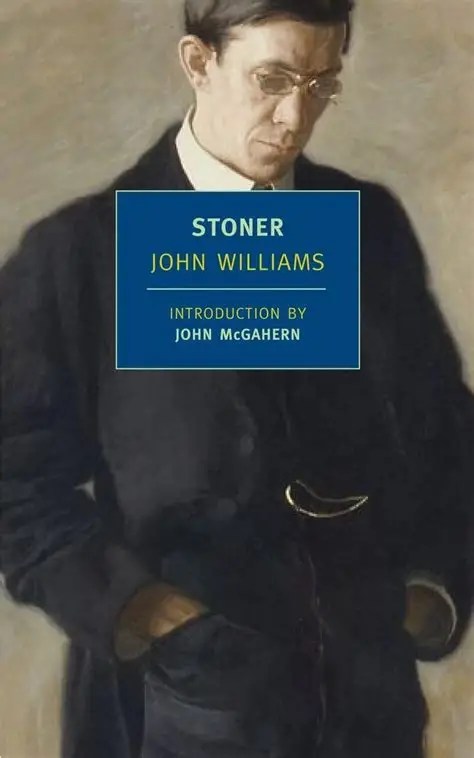
My initial reaction to this story was far from positive. Upon finishing the first chapter I had a line of thoughts that painted the story boring and unnecessary. It was not until the third chapter that the value of his insignificance began to sink in. Early into the book he is defined as someone who “(He) had no friends, and for the first time in his life he became aware of loneliness..” This moment of coming into oneself and for the first time being aware of the isolation of the world is a uniquely human experience. Following this moment, we see that Stoner is continually cut off from the acceptance and kindness of others. His life is one of solitude, and he is content to be condemned to that. It is easy to get lost in the desire to excel, but that life does not befit most people. There is a vast majority of people that will become like Stoner, moving day to day and inevitably being forgotten. This horrifying thought is presented so coldly by John Williams that it feels like just another part of our everyday lives rather than something that stems from our deepest anxieties. However, despite negativity, I find that this story urges people to live despite that dullness and loneliness. William Stoner is in no way that fit to be the focal point of this story, his life is boring and no different than anyone else, but are we to say that our stories aren’t also meant to be shared for this reason?
This story does propose one interesting thought to me, the idea that all the decisions we make lie entirely in a morally gray area that can only truly be understood by us. William Stoner has three pivotal moments throughout this novel. The first is when he makes the decision to turn away from his family business and pursue a career studying English. Despite making this large decision, he refuses to tell his parents until he is about to graduate with his degree. Stoner’s parents intended to pass their farm to him and had sent him to college for this sole reason, and despite this he chooses a pathway that he feels called to. In a sense he is turning his back on his family, but that does not mean he is the villain for doing something he loves. The next moment is his affair, something that I argue in a modern sense is inconceivable on its righteousness. With all that he has endured from his wife, he takes the chance on choosing time with another woman and from a critical perspective his life was never better. He treated his family with high regards even with his unloyalty, and they loved him for that. This is also the first time he truly felt what it means to love and to be known. The final moment in Stoner’s life that has a defining course is when he chooses to stand on the hill of protecting the academic circle of his university. This is the first time when he stands up not for himself but for something he believes in. To many it seemed futile but to him it felt like protecting the dream from an old friend. He made this decision not because of who the character was and their ailments, but rather because he was aware of the unpreparedness and was unwilling to waiver in his protection. These moments are cumulative in defining who Stoner became and analyzing how he evolved throughout the novel.
The characters are what define the story throughout the course of the novel and what drew me in and kept me connected to their world. I have not endured the same level of suffering, and my world seems far brighter than theirs, but somehow their uniquely boring experience kept me enraptured by it all. I would argue that it has become one of my favorite books solely on the fact that the narrative does not force you to like it, and the connection is a subtle build up as you progress through your reading. Stoner is an infuriatingly interesting novel in the way that I had originally dismissed it and have come to love the story for that deeper connection and the relationships between the characters.
John Williams created a world that mirrored our own and that has defined the success of his academic novel ‘Stoner.’ The characters in his story are realistic, and their actions feel entirely natural; they add to the story without being the major plot points. The story itself may appear boring at first, but it has fought to earn its label as a classic novel, and the themes buried beneath the words are timeless. One of the most significant things we can take from this reading is that our journey may not seem exciting at the moment, but the story that we’re living is always worth telling.

NEXT TIME: Beginners by Raymond Carver






Leave a Reply