
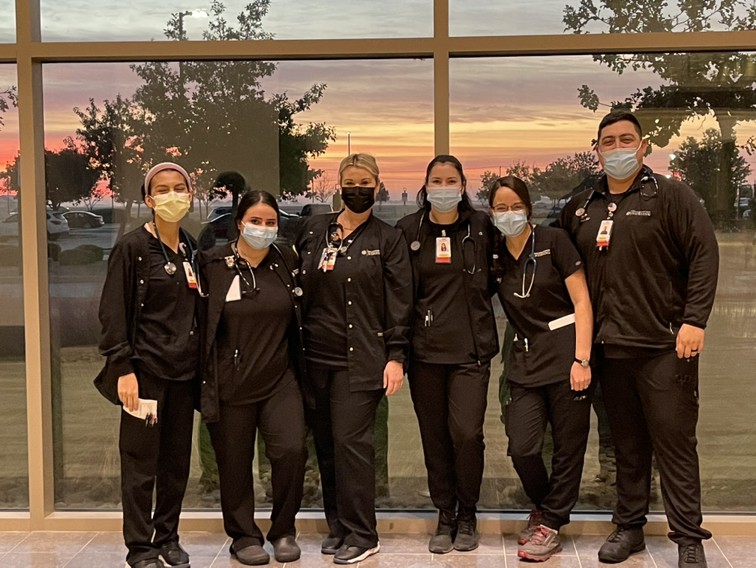
In the hospital I work at, I will often pass a room and see a bed raised to a ridiculous height with a group of people in black scrubs around it. By ridiculous, I mean that the patient had better not try to get out of bed. They would fall and break their leg. No, it is not a major operation. More often than not, it is simply an IV. The group of people in black scrubs are clinical students of the TLU ABSN program learning how to put in an IV. Just so you know, they do lower the bed once they are done putting the IV in. They do not leave the patient stranded. All that to say… nursing students have clinicals.
At the heart of the nursing program, there are two main categories of classes: regular classes and classes with clinicals. Regular classes, which can be anywhere from two to four hours, focus on teaching concepts while clinicals allow students to observe those concepts and practice some of the skills taught. Obviously, a student learning about labor and delivery cannot deliver a baby, even if instructors are there to help. Likewise, a nursing student learning about appendectomies cannot perform an appendectomy, thus there are limitations to what students can help with in clinicals. However, as mentioned above, IVs, catheters, and things like that can be done under careful supervision. Now that we have a more or less basic understanding of clinicals, we can dive into a recent TLU graduate’s clinical day.
For her final semester of clinicals, Abigail worked closely with a nurse in the ER, completing twenty twelve-hour shifts. Because this was her final semester, the nursing program required 240 clinical hours. Basically, when that nurse worked, she worked alongside her. She followed the nurse’s schedule for a semester.
Like the nurse, Abigail’s shifts varied from day to day in how they looked, but some things remained the same. She awoke at o’dark hundred (0500), and she was at the medical center and ready to nurse by 0630. She usually managed to take a lunch and was home between 1930 (7:30 pm) and 2015 (8:15 pm). In other words, she was gone before sunrise and back sometimes after sunset.
Working in the ER, she came across many different situations. Parents brought in young children who had fallen and hit their heads, older ones who had broken arms, ones who had fallen sick, and other people for various medical reasons. Because of the Covid pandemic, there was also an increase in teens trying to commit suicide. From learning how to communicate with worried parents to getting hands-on experience treating their children, these clinicals helped to grow her nursing and communication skills, allowing her to get a head start on overcoming some of the difficulties of pediatric nursing.
One particular situation she mentioned was the parents of a suicidal teen. This was not the first time the teen made an attempt by overdosing on mental medications, so talking with the parents presented some challenges. Both of the patient’s parents were medical professionals, and the patient’s dad worked in the hospital on a different unit, so emotions got into the mix which made communication difficult. Once the teen was stable, the parents became embarrassed over the suicide attempt, and that did not help communication. Part of the awkwardness stemmed from different emotions that arise concerning suicide, but some of it stemmed from their co-workers getting a glimpse into their life that they were uncomfortable with sharing.
Another memorable moment from her capstone was when a little boy of about two years old kept staring at her through the window. She gave him a small wave, and suddenly they were best friends. Another time, at a different location, she was able to sit down with a patient for several hours and just be there to listen. As a student, she had little paperwork or meds to give, so she had the ability to listen in a way that most healthcare professionals cannot. Afterwards, the unit director found her and thanked her for taking the time, saying the patient could not stop talking about the nursing student who took time to talk with her.
Like nurses, students can see anything in clinicals. There are clinicals in psychiatric hospitals, labor and delivery units, emergency units, orthopedic units, and many others. Students can learn so much through observing and asking questions throughout this unique opportunity, and in some cases, they may even be able to take part in procedures. And, like Abigail, even if a student cannot actively give medicine, they can learn how things work by interacting with medical professionals and taking time to show people they care—which can go a long, long way. Stay tuned for next week’s article!





Leave a comment