

Simone-Lucy-Ernestine-Marie Bertrand de Beauvoir was born on January 9th, 1908, and grew up in Paris, France, with a Parisian family of aristocrats. From an early age, Simone rejected the traditional values of her family’s ideologies, which expected her to seek purpose in the ever-exciting role of being a housewife. She valued the intelligence her father had and quickly showed interest in learning, so she began attending school at the age of five. It wasn’t long before Simone was reading great works of literature and was encouraged to write her own texts. Beauvoir had a desire to live a life for the purpose of experiencing, despite what the world believed she should want.

In her teenage years, her family experienced bankruptcy following World War I, leading to her parents’ concern for providing Simone and her sister, Hélène, with a dowry for a qualified husband. To Simone’s luck, she wanted the farthest thing from a husband and dreamed of being a successful writer and teacher. Hélène did not have the same luck, and contrary to her family’s original belief, education became Simone’s way out of an unsatisfying life after being enrolled, along with her sister, in a prestigious convent school.
At the age of 14, Simone and her mother distanced from one another due to a sudden refusal from Simone of God’s existence. Though she was raised Catholic, heavily by her mother, Simone realized herself to be atheist. Without wasting any time, she switched her study of religion to mathematics, philosophy, and literature. Much of her perspective on her youth is written about in her book, “Memoirs of a dutiful daughter”.
“…my father’s individualism and pagan ethical standards were in complete contrast to the rigidly moral conventionalism of my mother’s teaching. This disequilibrium, which made my life a kind of endless disputation, is the main reason why I became an intellectual.”
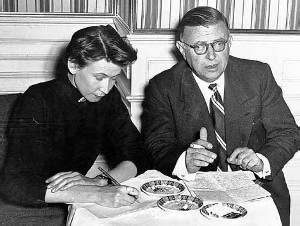
By the age of seventeen, Simone graduated high school and later attended Sorbonne where she would continue to study Philosophy and get her dissertation. By the time she graduated with her Masters, she was only the 9th woman to graduate from the university. She met Jean Paul Satre while studying for the agrégation and they quickly considered each other intellectual companions and lovers due to their similar views in existentialism and passions in academia.
In 1949, Simone published her groundbreaking book, The Second Sex, which catapulted her into the public eye for decades and sparked conversations that are still relevant today. The book spans an impressive 1,000 pages and provides a thorough critique of patriarchal culture, highlighting the damaging perspectives that have historically relegated women to a “secondary” status compared to men. Funny enough, Simone did not initially intend for her literature to evolve into one of the first foundational works of the Second Wave Feminism movement. In fact, for much of her early life, Simone refused to label herself a feminist, believing that the term came with certain limitations and expectations. It wasn’t until 1972, a full 23 years after her initial publishing, that she publicly declared herself a part of the movement. Though the book faced deep criticism from various quarters and was even banned by the Vatican for its provocative themes and ideas, it nevertheless found its way into the hands of eager readers, being published in English in America just a few years later. This accessibility allowed wider audiences to engage with her ideas and ultimately contributed to shifting societal views on gender roles and equality.
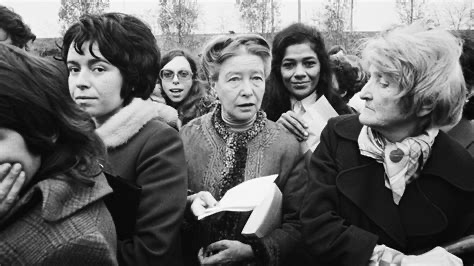
In The Second Sex, De Beauvoir first speaks of the differences between sex in terms of physiology and psychology before delving into the history of women, emphasizing the primary differences between men and women expanding beyond just the biological lens. As well as exploring the position of women in Ancient Greece, Medieval Europe, France, and the USSR, Simone emphasized the importance of the environment women live in and the social attitudes that influence them; including the differences in how boys and girls are raised and rejecting the emphasis on a woman’s role to be a mother if it is not her desire to be one. In Simone’s framework, neither biology, psyche, or economy can predetermine the way a woman is perceived by the society she lives within, stating the issue of inequality to be foundational and detrimental to social freedom for women.
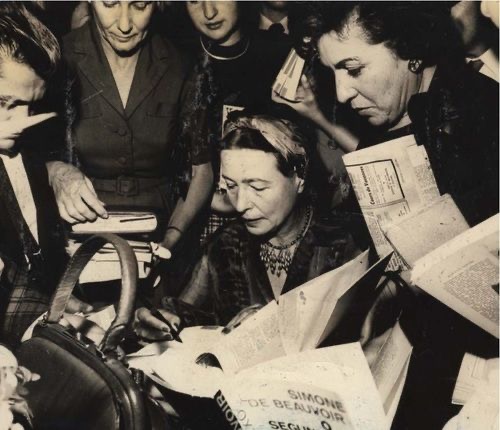
“One is not born, but rather becomes, a woman.”

By the 1970s, Simone De Beauvoir’s profound philosophical perspective was being taught by western universities, significantly influencing the academic landscape and inspiring countless students and thinkers. Her work opened up new methods of understanding the complexities and oddities of the female position within society, challenging traditional notions and prompting deeper explorations of gender equality and identity. Additionally, her insights extended the conversation of feminism beyond the simplistic framework that suggested sexes differ only by natural predetermination, inviting discussions about social constructs and personal agency. As a result of her groundbreaking contributions to literature and philosophy, Simone would later be nominated three times for the prestigious Nobel Prize in Literature, a testament to her literary genius and influence. Ultimately, she was awarded the Austrian State Prize for European Literature in 1978, solidifying her legacy as a key figure in both feminist thought and existential philosophy.
Citations
Sus, Viktoriya. “Understanding Simone de Beauvoir’s Feminist Existentialism” TheCollector.com, July 24, 2023, https://www.thecollector.com/simone-de-beauvoir-feminist-existentialism/.

 Official Website of Texas Lutheran University's Student Media