
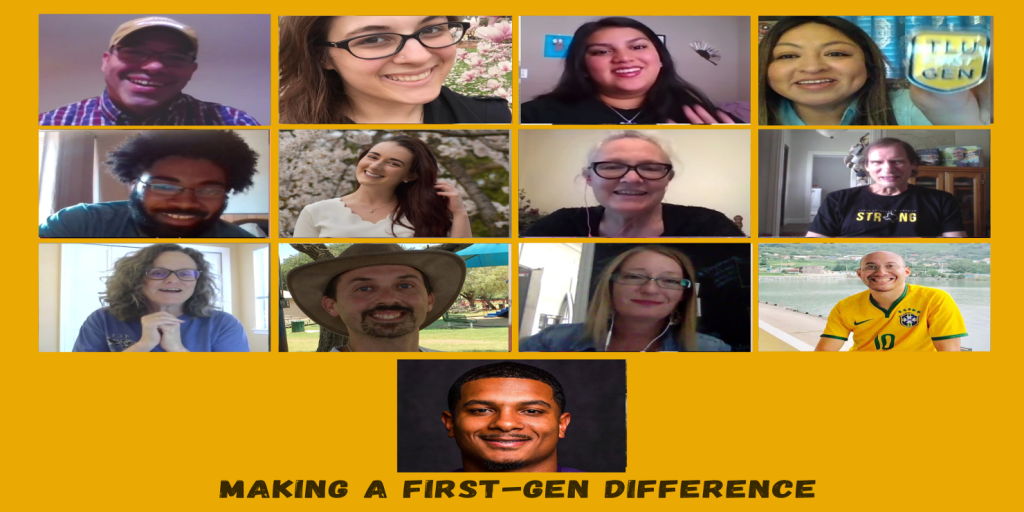
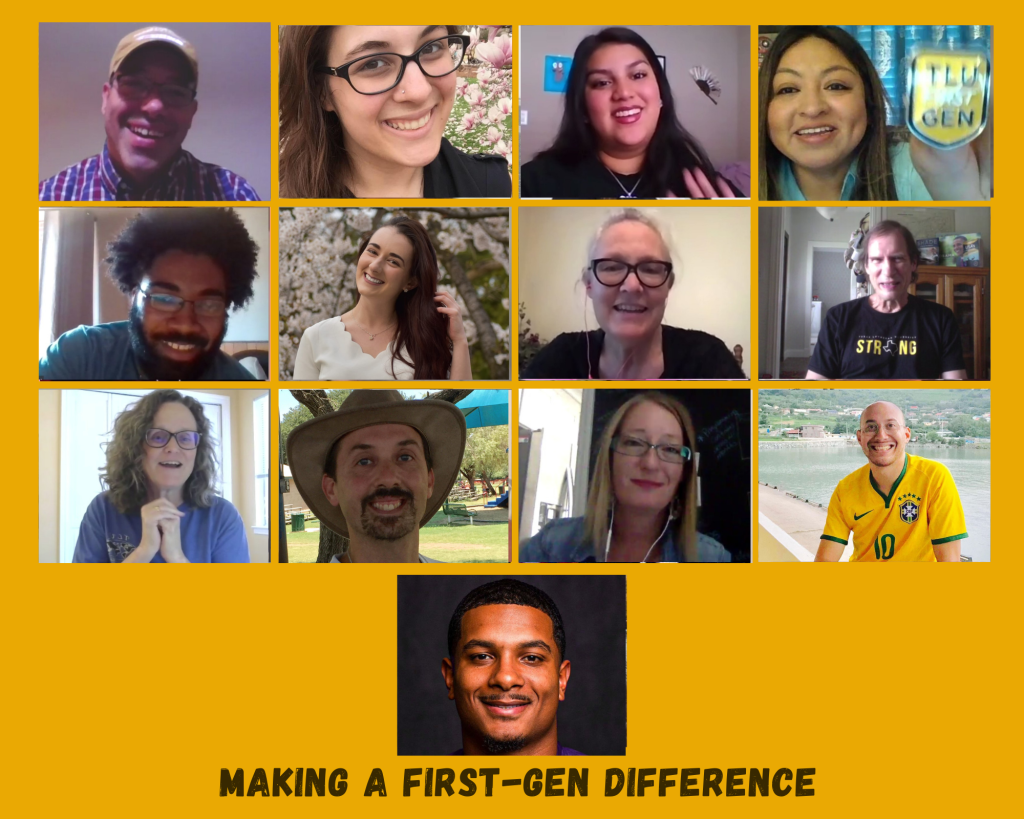
Dr. Chris Bollinger, Haley Czarnek, Jacklyn Mata, Samira López
Rashad Tolbert, Miranda Taylor, Dr. Robin Bisha, Dr. Robert Jonas
Dr. Pamela Johnston, Cory Frazier, Sarah Umbarger-Wells, Nick Hayes &
Adam McGuire
Well folks it seems as though the First-Generation series is coming to an end for now. However, that certainly does not mean we should stop educating ourselves on the matter as the First-Gen population will only continue to grow as more and more students take that leap into a whole new world. Because of this, we should provide as much support for them as we can. The people we will be mentioning today will tell us how they have influenced First-Gen students and how they have also been influenced by the First-Gen title.
As mentioned before, educating yourself on First-Generation matters is one of the best steps you can take in helping First-Gen peers and colleagues. To start, defining what First-Generation means to you and your college. Even First-Gen students do not always have the knowledge to know that they are First-Gen themselves because it is something not talked about often. As Haley Czarnek tells us, “The school [Texas Lutheran University] provided a lot of first-gen programming, but I never really thought I counted as first-gen until after I graduated.” Had it been better communicated for Haley, she could have gotten the resources she needed and also maybe have had found a support group of other First-Gen students. There is a communication problem between most colleges and the idea of who is First-Generation it seems as Haley is definitely not the only student who did not realize they were First-Gen. However, colleges are progressing now more than ever and making sure they provide proper accommodations for these students when needed. Samira López, the director of the First-Generation organization at Texas Lutheran University (TLU), did just this. She got together with a group of First-Gen students and “created an electronic path” which would track a First-Gen student’s progress so that which would ultimately allow them to get a First-Gen stole if they completed it. She believes that for students they will think, ‘If I follow this electronic path, eventually it’s going to lead me to an incentive’. This incentive would push students forward to graduation, which is so important as First-Gen can often feel lost and as if they are an imposter on campus. With that in mind though, what exactly motivates a student to continue their education altogether? Sure an electronic path is an awesome incentive for continuing to stay in college, but what motivates a student to keep on doing well in college itself? It turns out, these questions can have multiple answers.
Though there are multiple ways First-Gen students can stay motivated, having support from others is a big factor. This should not come as a shock, but it is important to address. First-Gen students might feel as though the journey they walk is only meant for them and them alone, but they should realize that so many others are on that journey with them. As Dr. Bollinger states, “Be willing to help each other and seek help” and even goes further beyond that and states “nobody is successful without having has some advantages from the people around them”. This is so true as everyone has benefitted from someone else’s company in some way, big or small, depending on how you scale that help. It would be near impossible if not fully impossible to do a task completely by yourself. Think of all of the resources you have at your disposal, what tools you are using to complete something, the text you are reading to complete a task, all of that was made by people in order to help you better yourself and potentially your education if you are still in school. There are many people who influence our daily lives and as Nick Hayes tells us, “there was Profesora Padilla. I think she is most responsible for me becoming an educator. She reached out to me in a way that no other Spanish teacher had before and made me realize the power of an educator who cares”. This also relates to what Cory Frazier thinks as he says that, “Charla Bailey and Mark Gilbertson, my initial advisor, really helped the ‘have no idea what I want to be’ version of myself find my strengths and ultimately what I truly enjoyed learning and doing”. Both of these gentlemen had professors, faculty, and staff that influenced them directly at TLU. Their lives could have been completely different if it were not for these people and from what it sounds like, they might not have been as successful if not for these individuals. It is not limited to just them though as your peers can also be an awesome support group for you. As Jacklyn puts it, you should be “getting involved.” and also “getting into whatever clubs you want” as this is where you will find people with commonalities like you. This can even be put into a bigger picture about finding people who you identify with in terms of background. For Rashad Tolbert, he remembers that “I didn’t see many black people, especially black women outside of football” and it was not until he joined the Black Student Union where he found more black students to relate with. Often, we forget that First-Gen students feel alone in this new environment and that can be amplified when they do not have others they can relate or rely on. Of course, this is not the only way students stay motivated in college.
Besides people though, there are other ways students can stay motivated. These ways might seem more concrete in regards to what the student actually wants to get out of college and what they hope to achieve while they are there. For someone like Dr. Johnston, she wanted to go to graduate school and complete her First-Gen journey there. She does tell us though that in her eyes, she had a bit of a rough start as “when you go to graduate school, you are expected to get As” so she felt like she “was on the doorway of failing (with a B- on assignment)”. This actually ended up motivating her as she wanted to do better and not feel like she was failing within the class. Eventually, she got her A that she wanted and now teaches right here at TLU! This story is similar to Dr. Jonas’ story as well as he “took a math course and it was precalculus and I already had advanced math in high school so I thought it would be easy” but he ended up getting a low test grade for his first test. Instead of letting this bog him down, he planned to pick himself back from it. Now he simply looks back at it as a lesson for his students that failure can happen and it is important that you do not dwell in it and think of yourself as a failure. For others though, grades might not have been the deciding factor in staying in college. Dr. Bisha recalls that she kept thinking to herself “about what I didn’t want” and in those thoughts she “kept thinking about knife fights in the high school and those things didn’t seem to happen in college so I was going to finish that PhD no matter what”. She was a substitute teacher then, but she did not want to be one any longer because of the stressful environment. This is what led her to be a college professor instead and she is happy to be teaching in a better environment where she does not feel threatened. All of these reasons and more are what has kept these people going and it eventually led to bigger and better things for them.
To end this post off, it is finally important to address just what First-Gen students should remember and what they should being aiming for. This blog is obviously not here to tell you how to run your life, but it is important for First-Gen students to remember their worth and for them to remember that they are not alone. Sarah Umbarger-Well from the Center for First-Generation of Student Success (NASPA) exclaims that “First-Generation students are as likely to be from middle class as they are from lower income family systems” and that they are likely “to be of Caucasian race as they are to be from African American race”. Again, anyone can be a First-Gen student, so that feeling of loneliness can easily be broken as First-Gen students can more than likely find someone who has gone through a similar experience like them if they look for it. With that said though, what should First-Gen students aim for especially after graduating? After you have felt that sense of completeness in college, what do you do after everything is said and done with college? Miranda Taylor’s piece of advice for graduating First-Gen students is “for graduating first-gen students, I would encourage them to save as much as they can” which is really and truly solid advice for any graduating student. This new sense of freedom may make former students feel as though they can do anything, which they most certainly can, but having that sense of self-control mixed with ambition is important to be successful beyond college. Above all though, Adam believe that . “You can’t give up no matter how hard it gets, because that’s the easy thing to do. Be different, aim high, and always look for a reason to keep going. It’s always worth it in the end”. Certainly this is what we should all strive for, to never give up as it is always worth it in the end no matter if you are in college or have completed it. There is always something forward to look towards.
For First-Gen students, what you seek and what you want is whatever you desire, but just remember that the world is your oyster. You decide your fate and you are already taking that first giant leap into bettering yourself. There are so many people behind you that want to see you succeed and one of these people should be you as you are capable of greatest. Follow your dreams trailblazers, you all have something to accomplish.
YouTube videos that were used for quotes:
https://youtu.be/ctNhAjgMFmo
https://youtu.be/koXfbd3IM60
https://youtu.be/7MQakb21-jw
https://youtu.be/_D4rqmqUkpU
Written by Jordan Mendoza

 Official Website of Texas Lutheran University's Student Media