
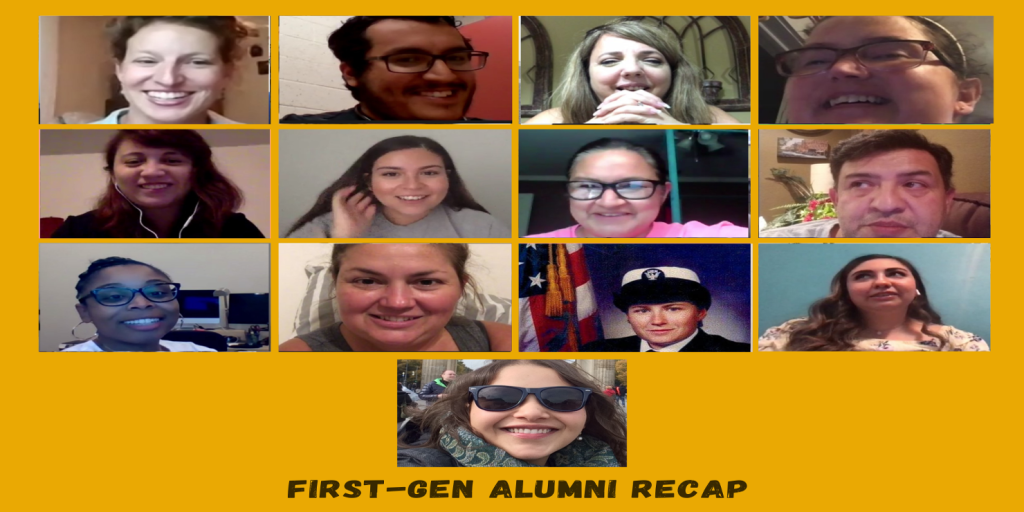

Ashley Dellagiacoma, Carlos Gilbert, Beth Alvarado, Amy Fey
Laura Torres, Tyler Salinas, Claudia Mendoza, Arnulfo Reyes
Necie Green, LeAnn Maries, Carolyn Baker, & Chelsea Kohutek
Jas Heldnandez
Hearing the words from those who have already done college can be uplifting as they know what current college students are typically going through. They often have words of wisdom to share because they have gone through it themselves. Whether it be challenges or strengths, these First-gen alumni have gone through it all.
One of the biggest part of college is actually deciding what college you want to go to and also how to navigate that college. Sometimes that decision of where you are going can be tough, but other times it can seem pretty simple once you are on campus. This is exactly what Amy Fey believes as she says that “It just came to, it was a no brainer, once I visited on the way home I told my parents, ‘This is where I’m going’” after her visit to TLU. Of course, that’s just the first step into college. Getting into college and actually doing it are two different things after all. As Carlos Gilbert tells us, “Being first generation, it was tough getting into school because I didn’t really have much guidance on financial aid, what you have to do for registration”. Once in college, he was obviously unsure of what to do because he did not have the necessary guidance. As we have talked about previously, First-Gen do not a figure to help them like someone who has had someone in their immediate family go to college. If you think this feeling goes away even after undergraduate college, then you would be mistaken. Chelsea Kohutek says that “My parents still don’t know what I’m doing like I’m in grad school now”. It would seem that there will always be somewhat of a disconnect between parents and students simply because experience beats explanation. It does not mean First-Gen students do not need to stop explaining their experiences, but it does mean that there should be a mutual understand between both parties. It is also important to discuss that sometimes First-Gen students do not even have someone to depend on at all sometimes. LeAnn Maries tells us that “I actually didn’t have parents by the time I went to college, I was on my own for about a year before I went to TLU” which would make her college experience way more challenging than even the average First-Gen students. Understanding the multi-layer factors of a student, even past the First-Gen status sometimes, is key in understanding the overall student.
Almost all First-Gen students seems to desire one thing, the feeling of acceptance and the sense of belonging. One feeling that is common amongst almost all First-Gen students is the feeling of not believing that they belong at college or that they will not do good in this new environment. Carolyn Baker explains how she “went to high school and college, I felt like an alien from another planet. Like Dr. Who traveling back and forth between two different worlds. Two different cultures, languages, and social norms.” It is also worthy to note that at TLU in 2018, there was about 65% of Hispanic students that were First-Gen. I wanted to mention this as many of the First-Gen interviewees have been Hispanic and other minorities that have expressed this sense of not fitting in college. Claudia Mendoza exclaims that “We didn’t have a lot of Hispanic students” in her college. While she was there “I feel like everyone kinda expected me like, ‘she’s not gonna do it’”. It would seem that Claudia did not originally feel this sense of belonging within her own college simply because she was Hispanic. However, being a minority on campus does not mean you cannot feel a sense of belonging and community. Both Lauren Torres and Necie Green felt comfortable with college once they joined a club that was centered around their identity. Laura Torres explains that “Finding MASA was what really helped me” “It was really nice to connect with those individuals” and Necie Green believes that what really helped her was “meeting with some of the students, having them tell me about BSU I already felt connected”. This is why clubs focused around minorities are so important. It grants students the feeling of belonging as if it is their second home some way. Understanding this and what other factors makes First-Gen students feel acceptance is what really needs to be focused on.
Since we are discussing alumni, it only makes sense that they are thinking about the past and wanting to reminisce on their experiences. As with any past achievements, it’s good to look back and see what you have done before and what those achievements mean to you. Ashley Dellagiacoma explains this perfectly as she thinks that “when you’re reflecting on your college experience with the folks back home and they have no frame of reference for that”. It would seem that reflecting back on the college experience is also hard for parents to understand when explaining it like Chelsea was telling us earlier. Though of course reflecting back on this does not mean that their parents do not support them on their journey, just that they might not fully understand their struggles. Reflecting back on college has its good moments though as Tyler Salinas would tell us that “I think I like became a better student and a better person and was like able to critically think better because I sought out things that were interesting to me”. In this sense, finding her own path was what she saw as successful in college. She did not want to do what she believed what everyone was doing and sought her own creative endeavors.
Sometimes though, reflecting on your college experience might show that going to college was more than simply going to college for oneself. Sometimes going to college is for the betterment of yourself and others like family. Arnulfo Reyes exclaims that “I impact the community as far as these students to be able to provide them with things” as he is a teacher who helps students however he can. Whether that be supplying the students with pencils or advice, he feels like he makes an impact on those students from his experiences. Beth Alvarado also feels like she makes a difference, but more close to home. Beth believes that “I needed to be an example for my child” as she went to college later on and not immediately after high school. This presents a whole new set of challenges, but she does believe that it was worth it for herself and her son. She wanted to be that example for her son and to show that it was possible to do school even after many years out of college.
As these alumni give their piece of mind and advice on the college experience, it is important to realize that these former students went through a lot of what current students go through now. Though there are differences between the two, the similarities are definitely outweigh those differences. The feeling of wanting acceptance in college, going to college for yourself and others, and trying to navigate college is what almost al First-Gen students experiences. In the words of Jas Heldnandez, “I suppose this is what being a first-gen college grad really taught me: to keep fighting for what I wanted, regardless of statistical probabilities in failing”. Fighting for what you want is the key to success for college students. Fighting past all of the adversities and going for what you want is the most important part in college so that you can better find yourself.
YouTube videos that were used for quotes:
https://youtu.be/_bXCS0ugE3E
https://youtu.be/_wd5GnjKwDQ
https://youtu.be/viyYe2hCaYo
Written by Jordan Mendoza

 Official Website of Texas Lutheran University's Student Media