
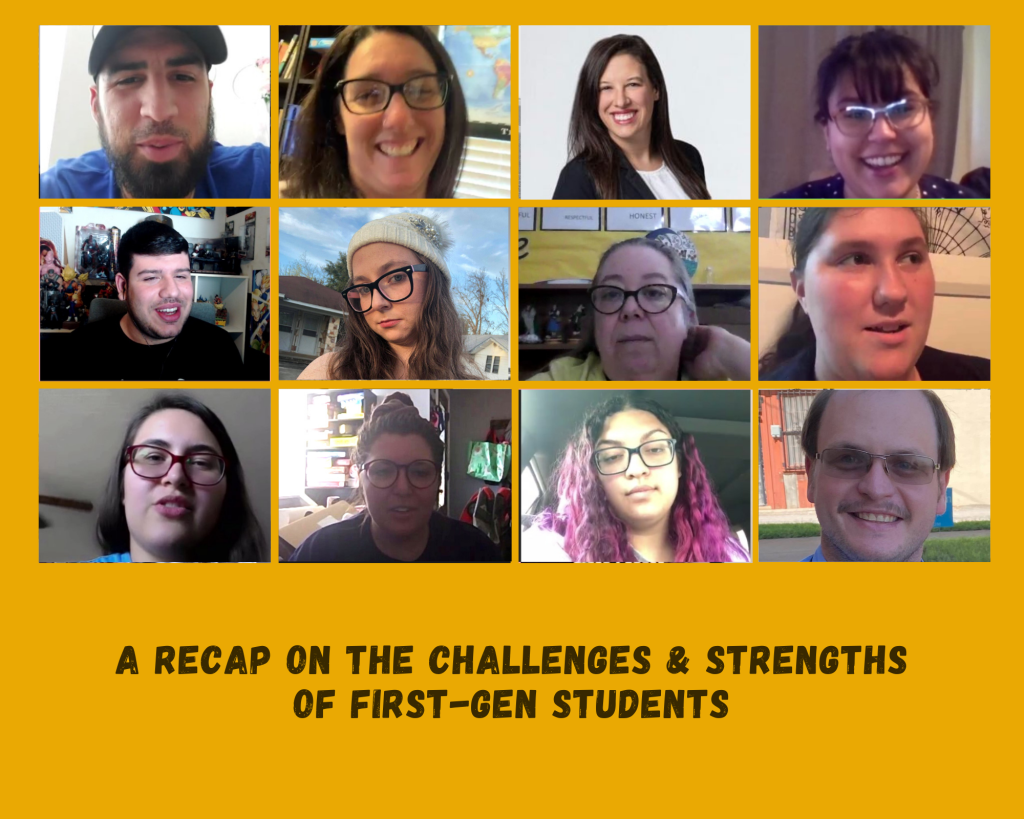
Rudy Ortiz, Melissa Boney, Megan Ochoa, Alex Longoria
Jordan Mendoza, Jessica Miles-Wallace, Amey Szanto, Gracie Schwartz
Brittny Raup, Sharon Murphy, Daeme Machado, & Nolan Schmidt
In our previous blog post, we discussed the current First Generation college student discourse and also how they are in the midst of some of the wildest times with the Coronavirus. Understandably, this is a stressful time for all students currently and there are many challenges that come with this new way of schooling. However, First-Gen students are used to facing new situations and challenges head-on in many different ways. No one could have expected Covid-19 to be this life-changing obviously, but First-Gen students have to deal with this same feeling of the unknown almost entirely throughout college as well because they can not rely on their immediate family or guardians to guide them. On the other hand though, being First Generation does not always means that you simply face challenges as there are actually strengths to it as well. The typical stereotype for First-Gen students is that their lives are hard and that they totally clueless in college so they are likely to not thrive in this new environment. This is not the case though and there are many instances where First Generation students can find strengths in a variety of different ways that people do not typically think about. Because of this, First-Gen students can experience facing new challenges and finding new strengths along their college journey.
Let us start with what most of us already believe to be true about First Generation students, they are going to face new challenges and likely not have guidance in the beginning of college like other students. This can be traced back to the roots of what it means to be First Generation, the fact that you are the first to go to college/a four year university in your family so you basically have to find out everything on your own. Sure you can have support from your family or guardians, but they can not obviously understand something like financial aid, where to go for certain information, who to contact, etc if they have not gone through that experience themselves. As Brittny Raup tells us, “I basically had no one to look up to; pretty much like I was basically the first one on both sides of my family to go to college”. This is generally the reality for First Generation students. It can be rough going into a new place without that mentor presence by your side. On top of this, it can also be frustrating if you do not connect with other people that understand what you are going through. You might be able to find other First Generation students and they will be able to understand your struggles, but finding other First-Gen students can be difficult in some cases. Amey Szanto exclaims how non-First-Gen college students “do not understand the life of a person that doesn’t have the same privilege they have” and she relates it back to how it is similar to white privilege and socioeconomic privilege. This is not to say that she wants people to feel guilty, but that she wants people to understand that it can be difficult for others to understand something that you have not experienced before. Non-First-Gen and First-Gen students get along all of the time of course, but there is a gap between the two that is not always communicated well enough within colleges. Furthermore, Sharon Murphy communicates to us that there can be a huge “culture shock” and that it “was something I really did not expect at all”. She tells us that even though she prepared for college to the best of her abilities, she could not expect this sudden change in political atmosphere. Growing up conservatively, she experienced a dynamic shift from her politics she grew up with and with the politics of her college. She did not hate it though, quite the opposite in fact, as she told us that she was glad she experienced it and got to learn something different. However, this also did make her feel uncomfortable at times as she did not always want to speak about her beliefs as she did not want to offend someone else. Though this can be a specific challenge for one individual, many other First-Gen students might feel similarly to Sharon if they are not accustomed to what to fully expect from college and many new students can experience this culture shock in different ways.
Part of the experience with facing challenges though means that some kind of resolution must come about it and generally, First-Gen students are able to overcome these obstacles. Gracie Schwartz tells us about how one of her biggest challenges was “Whenever I decided to change my major after my first semester there [Texas Lutheran University]” as her mom initially thought she had wasted a semester there at TLU. After Gracie explained to her mother how the process worked and that she just took her basics that semester, her mother understood where she was coming from. Again, it is hard for someone to understand a certain situation if they have not gone through it themselves, so that is why First-Gen students need to explain and assess the situation in order for others to better understand their challenges. Nolan Schmidt explains how he “overcame getting used to the atmosphere by getting familiar with the entire campus as well as communicating with my professors and fellow students” which might be a tactic to also overcome the culture shock that one might go through in college. Finding people who can relate to First-Gen students or at the very least, getting familiar with other people on campus, seems to be the key in helping students on their paths. Even Jessica Miles-Wallace believes that communicating with someone like your professors/advisors can help you in your First-Gen journey. She experiences dyslexia, but exclaims to us that “luckily, Dr. Levins was one of my first biology Professors and my Bulldog Basics advisor. So, when he saw me struggling he reached out. And set me up with the Meadows center. After that, I got better about telling people what I needed in all aspects of life!”. Not only did she overcome her initial fears of reaching out to people, it seems that this is something that will impact her for the rest of her life as well. Overcoming these challenges is a part of the First-Gen experience, but there are also other times where being First-Gen can actually be a strength for people.
While challenges and First-Gen students are necessary for us to recognize, it is also important for us to realize that there is more to First-Gen students than just going through struggles. There should be pride in being First-Gen and knowing that you are the first one in your family to take that initial step into a whole new world. As Melissa Boney puts it, “it makes you appreciate what an opportunity you have in front of you”. She goes on by stating that “when you’re tired and you’re stressed and you feel like quitting, I feel like the passion and determination is what really keeps you motivated”. This determination and passion is what many students rely on when going through college. Let us face it, college can be tough. If you do not have that drive to complete it, then you are more likely to not want to complete it or at the very least, not necessarily enjoy your time there. That is why it is so important to find whatever motivates you or helps you along that journey. Daeme Machado expresses how Texas Lutheran University has helped her along the way as “at TLU especially, there’s like programs and people that are there for First-gen students”. Colleges should also do their part in making these students feel welcomed too and realize the diversity of the student body. Simply clumping everyone together without proper resources and accommodations can lead to more student burnouts. For Daeme, she has used these resources at TLU and it has helped motivate her as she knows she is not alone on campus and knows there is support for her as well. Even the students on campus can help play a part in motivating other students for college in a way that is not surprising, but might not be thought about. Alex Longoria says that for her on campus “you’d be walking to your class and everyone would just say hello or actually acknowledge you”. This might not seem like a big deal in the overall college experience to some people, but this can actually play a huge part in it as it makes people feel that sense of belonging. Alex goes on to tells us that she would think to herself “‘Ok, I’m acknowledged here, I’m a really person, I’m not just a number’” which obviously made all the difference to Alex as she felt as though TLU was her second home.
This opportunity of being First-Gen can further be more impactful even when college is over. The sense of completing something no one in your immediate family has done is actually really empowering and many First Generation students can take pride in it once it is over. In fact, now that these First-Gen graduates have the knowledge that they do now, they can pass it along to others and help them through their own journeys. Rudy Ortiz believes that “one of the strengths that I consider is kinda setting the bar and the standards for my future kids and family” since he now has experienced college himself. Since he has gone through all of the hardships already, he knows how to even further better help his kids and family and give them practical advise for when the time comes. This can also apply to other First-Gen students as they now have that first-hand experience of what to do in a lot of situations. Though it can be rough, especially in the beginning of college being First-Gen, it is important to stay positive and realize that this is actually a valuable opportunity for growing and learning. Megan Ochoa perfectly summarizes this as she states that “I am extremely grateful to be one of the first college graduates in my family because my opportunities are endless”. These opportunities have both benefited her while she was in college and now outside of it. All other First Generation students can also have these opportunities granted to them too as this new experience through college can prove to be fulfilling and rewarding.
Make sure to follow us on our other social medias (click the corresponding social media links to the right of this post) for the full interviews and posts!
YouTube videos that were used for quotes:
https://www.youtube.com/watch?v=L9jYCedNud0
https://www.youtube.com/watch?v=_dhNBmhQnfU
Written by Jordan Mendoza

 Official Website of Texas Lutheran University's Student Media